Nepal HMIS FHIR Implementation Guide – 🚨 DRAFT VERSION - Local Development build (v0.0.1-ballot) built by the FHIR (HL7® FHIR® Standard) Build Tools. See the Directory of published versions
For the elements whose value is from a set of (coded) options, a FHIR ValueSet should exist. SMART Guidelines can use Common ValueSets or define new ones.
ValueSets are used in
Logical Models
Profiles
Questionnaires
The L3 should use same codes as defined for LM
Inputs
DAK
SMART Common ValueSets
Terminology services to lookup and validate the codes
Outputs
ValueSets
Proposal for any common value sets
Activities
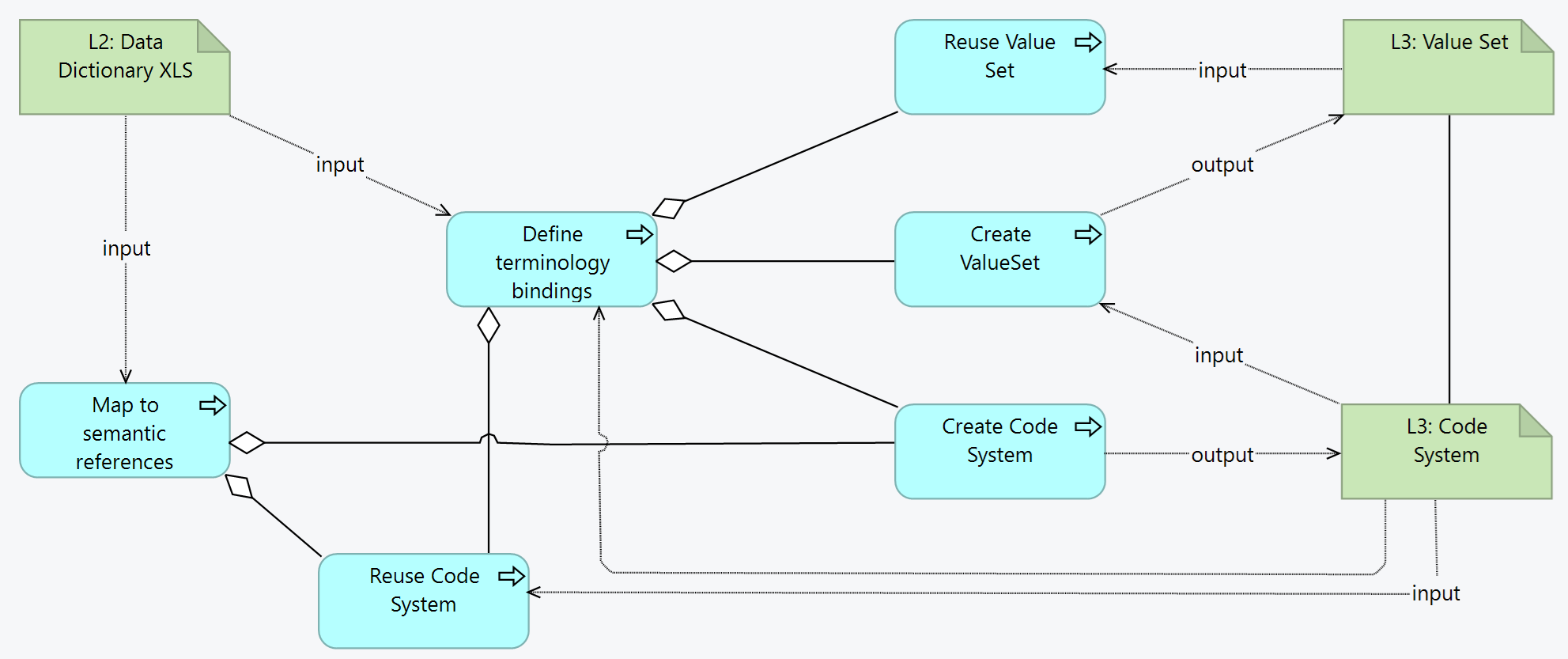
This is the overview of the activities and related artifacts used:
For each element in the DAK that has a value set - i.e. the answer depends on the options for the data element - for example sex, etc., the author shall have a value set. this can mean
Reusing a value set
Creating a new value set
only for the purpose of the current SMART Guideline
as a candidate for common value set
Functionally, the valueset in the L3 level must support the L2 expressed values. However, the actual codes are typically a L3 decision, unless the L2 imposes some codes. The L2 doesn't need to impose a code system, but may do so, for example as a result of an existing SMART Guideline.
The ValueSet should include codes from one of the preferred code systems which are:
ICD-11
LOINC
ICD-(others)
Open and globally available code systems without licensing restrictions
Jurisdictionally endorsed or required codes
Note that FHIR has codes that may be required or extensible - in these cases the FHIR values should be preferred - however, concept maps SHALL be in place between these codes and the codes above.
The creation of a value set may require the creation of a new code system
The creation of a value set may, in some cases, require changes to the profiles: If a FHIR resource has a binding that is too strict and the L2 model requires a broader value set, normally a new element or extension must be created.
For example, adding a gender "changed" to the Administrative Gender Value Set - that is not supported and would require mapping the element and its value set to a new extension in FHIR.
Given the impact of this, any such deviations should be identified and discussed with the L2 author who can evaluate consistency, value, and the real need.
ValueSet creation:
Add "Shareable", “publishable” extensions
ValueSet reutilization:
ValueSets may be reused if the application needs are consistent.
While reusing of ValueSets is recommended, authors should be aware that a reuse also introduces a dependency
ValueSet validation: The ValueSet should be valid against the SMARTValueSet profile
CodeSystem creation
When defining a ValueSet, there may be a perceived need to create a CodeSystem:
Review procedure
ValueSets shall be reviewed for criteria
Output Criteria / Definition of Done
All the elements in the L3 that have coded values shall have a corresponding valueset
All the values in the valueset shall be valid codes:
Available in an available code set (for example no SNOMED unless SNOMED is supported)
Not deprecated
Terminology Services
lookup
mapping
validate
Terminology Value Sets
The following value sets have been defined for this Implementation Guide: